
Alamogordo, New Mexico — April 2026
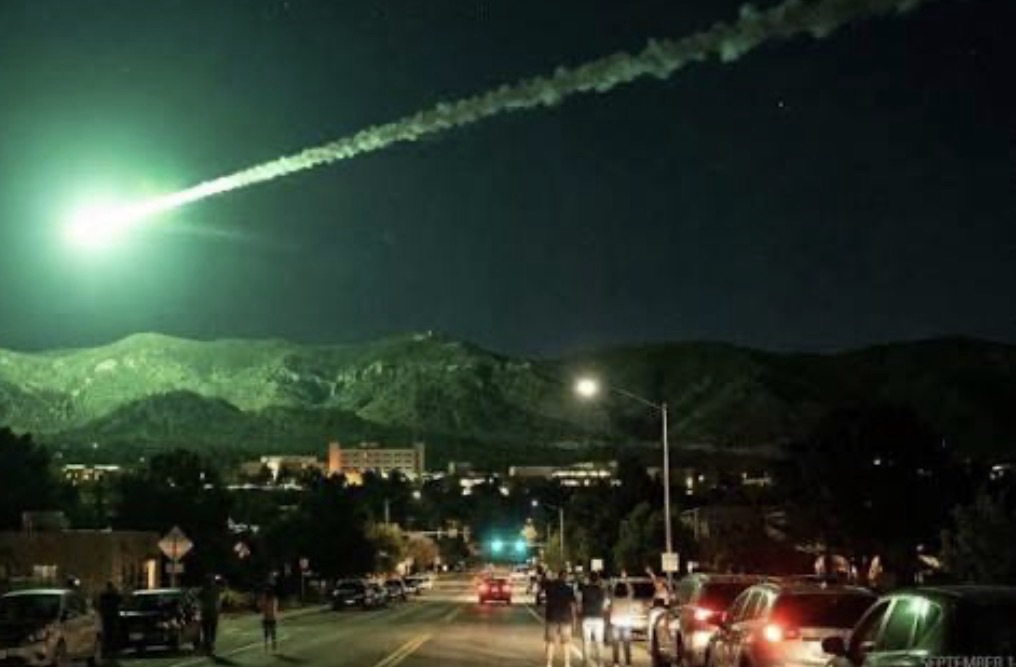
In the high desert of southern New Mexico, where the gypsum dunes of White Sands stretch under vast skies and Holloman Air Force Base sits near the edge of the Tularosa Basin, locals have long whispered about strange lights in the night. While Roswell to the east claims the most famous UFO crash of 1947, Alamogordo and the surrounding region played host to one of the most scientifically scrutinized aerial mysteries of the early Cold War: the Green Fireballs.
These luminous green orbs, witnessed primarily between 1948 and 1951, were no ordinary “lights in the sky.” They appeared over some of America’s most sensitive nuclear and military installations — Los Alamos National Laboratory, Sandia Base in Albuquerque, and White Sands Missile Range, with sightings also reported in the Alamogordo area near Holloman AFB.
The Sightings: Brilliant, Silent, and Defying Explanation
The phenomenon kicked off in late 1948 and peaked in 1949. Witnesses described vivid “chartreuse” or luminous green balls of fire, far brighter and larger than typical meteors. Unlike meteors that streak downward at steep angles and leave smoky trails or sonic booms, these objects often traveled on flat, horizontal paths, sometimes appearing to level off or change direction. They moved at high speeds yet remained completely silent.
On December 5, 1948, two separate flight crews — one military and one civilian — reported seeing what looked like a “huge green flare” that seemed under intelligent control. Sightings continued into 1949 and beyond, with dozens of reports from pilots, military personnel, nuclear scientists, and ground observers. Many came from trained experts who knew the difference between aircraft, meteors, and something anomalous.
One notable account placed a bright green fireball visible near Alamogordo. Skeptical astrophysicist Donald Menzel later claimed to have seen a similar green object there in May 1949, which he attributed to a meteor — though many other witnesses disagreed with such easy explanations.
Government Alarm and Project Twinkle
The U.S. government took the sightings seriously. With the Cold War intensifying and America’s nuclear program centered in New Mexico, officials feared the fireballs could be Soviet spy devices, radiological weapons, or some new enemy technology probing atomic secrets.
Dr. Lincoln LaPaz, renowned meteor expert and head of the University of New Mexico’s Institute of Meteoritics, was brought in. LaPaz, who personally observed one of the objects, insisted they were not meteors. He noted the lack of sound, absence of dust trails or sparks, and — crucially — that searches of predicted impact zones turned up no fragments or craters despite precise calculations.
In February 1949, a secret conference convened at Los Alamos. Attendees included scientific heavyweights like Edward Teller (father of the hydrogen bomb), Laboratory Director Norris Bradbury, and military intelligence officials. They debated whether the objects were natural or artificial. The fireballs were even grouped with “flying discs” under early UFO investigations like Project Grudge.
This led to Project Twinkle, a dedicated Air Force effort starting in late 1949 to photograph the phenomena using cinetheodolite cameras at stations near White Sands. The project was never fully implemented — only one camera station operated effectively — and sightings reportedly decreased once monitoring began. The final 1951 report concluded that most observations, including the “Green Fireballs,” were likely natural phenomena such as meteors, airplanes, balloons, or birds, with no evidence of anything extraordinary.
Yet LaPaz and others remained unconvinced. Some speculated about secret U.S. or Soviet technology; others, including LaPaz in private views, leaned toward non-human artificial objects possibly monitoring nuclear activity.
Enduring Theories and Local Lore
Theories persist today:
• Natural bolides: Rare green meteors caused by copper or other elements in the meteoroid, though the flat trajectories and silence challenge this.
• Secret military tech: Spy devices or experimental craft that self-destructed.
• Atmospheric plasma or ball lightning: Possibly triggered by high-altitude rocket and atomic testing in the desert.
• Extraterrestrial surveillance: The timing — right after the Trinity Test and amid nuclear buildup — fuels speculation that something was watching humanity’s atomic dawn.
New Mexico continues to report occasional green meteors and fireballs, with some locals around Alamogordo, White Sands, and the labs joking (or half-seriously believing) that the “monitors” never fully left. Modern fireball reports are tracked by the American Meteor Society, and the state’s dark skies make it a prime spot for skywatching.
Alamogordo’s Place in New Mexico’s Sky Legends
Alamogordo sits at the heart of this history. Nearby Holloman AFB and White Sands Missile Range were active during the fireball era, and the area ties into broader New Mexico UFO lore — from the 1947 Roswell incident (launched from Alamogordo as part of Project Mogul) to later tales like the alleged 1964 Holloman “non-human entity” landing. The region also boasts the quirky 1983 Atari E.T. game burial in a local landfill, unearthed in 2014.
Whether viewed as rare atmospheric events, Cold War paranoia, or something more, the Green Fireballs remain a fascinating chapter in Alamogordo and New Mexico’s rich tapestry of history, science, and mystery. On clear desert nights, many still scan the skies above the Sacramento Mountains and Tularosa Basin, wondering if the green glow might return.
To learn more about fireballs in the sky and potential UFO phenomena join fimmaket Larry L Sheffield and the premier of Cosmic Trigger at the Flickinger Center in Alamogordo on May 16th, 2026 https://www.etix.com/ticket/p/49882183/the-cosmic-trigger-alamogordo-flickinger-center-for-performing-arts
Have you seen unusual lights near White Sands or Alamogordo? Share your stories with 2nd Life Media Alamogordo Town News & KALH Radio.



Leave a Reply