
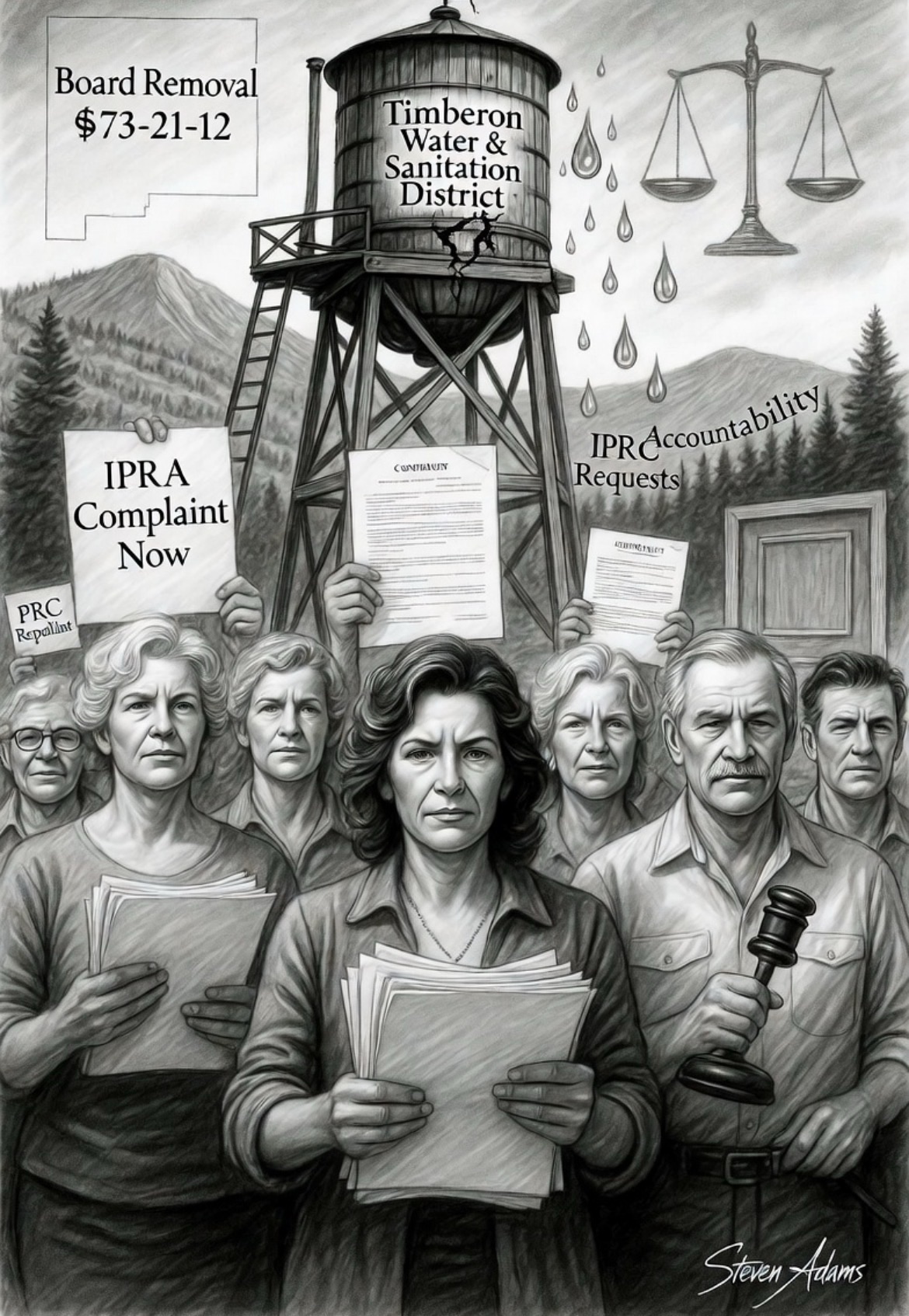
For years, residents of Timberon have endured water outages lasting two to three days a week, boil advisories that have become near-routine, and a system that by its own board’s admission loses up to 85% of its water to leaking, aging pipes.
Now, amid fresh public allegations that board-connected businesses have been spared the worst outages while ordinary ratepayers go without water to drink, shower, or flush a toilet — and a state finding that the district failed to even notify its own customers of a documented drinking-water violation — the question many residents are no longer asking is “what’s wrong?” They know what’s wrong. The question is: what can they actually do about it?
The answer is: quite a lot. New Mexico law gives citizens a layered toolkit of administrative complaints, regulatory filings, ethics challenges, court actions, and democratic removal tools. Every one of them is free to initiate. Every one of them creates its own paper trail, its own deadline obligations for the district, and its own potential for enforcement. What follows is an accounting of several options available — with the statute behind it, the agency that enforces it, and a live link to file.
1. Board Removal: The Most Direct Democratic Tool
The most immediate democratic remedy is removing the board members responsible for the district’s management. Under NMSA 1978 § 73-21-12 — Organization of Board; Meetings; Vacancies; Elections; Removal of Directors, the board of directors of a water and sanitation district is subject to removal procedures through the district court. Because TWSD board members are elected by taxpaying electors of the district, removal can happen through petition to the courts or through the ballot at the next biennial election cycle.
Equally important: under § 73-21-13, any vacancy left unfilled by the board within 30 days causes the court having jurisdiction — Otero County District Court in the 12th Judicial District — to fill the seat itself. That means forcing a vacancy, through resignation pressure or legal challenge to a member’s qualifications under § 73-21-11, hands control directly to the judiciary if the remaining board fails to act.
For recall specifically, New Mexico’s NMSA 1978 § 1-25-3 covers certain elected officials. Residents should confirm with an Otero County attorney whether special district board members fall within its scope or whether removal must proceed under the Water and Sanitation District Act directly. The two pathways are not mutually exclusive — pursue both. The existing case filed by former board member Mark Harding, PRC Case No. 25-00011-UT, is already on the record and provides factual foundation for any court petition.
2. PRC Complaint: A Live Case — Add Your Voice
The New Mexico Public Regulation Commission already has a live complaint against TWSD in Case No. 25-00011-UT. During a November 2025 hearing, Commissioner Patrick O’Connell publicly raised the possibility of receivership — the most drastic regulatory step available, which would strip the elected board of control entirely and place the district under a court-supervised administrator. “How many more Timberon issues do we need to see before we put the pieces together and say, ‘We need a bigger solution than a fine?’” he asked. That question is still unanswered.
Every individual resident who submits a personal statement to the PRC strengthens that proceeding. What to include: specific dates of water outages, boil advisories received, the names of any businesses you personally observed to have uninterrupted water service during an outage you experienced, any billing records showing inconsistent charges, and documentation of differential service between residential and commercial accounts. The governing statute authorizing PRC oversight of special districts is NMSA 1978 § 73-21-55.
File directly with the New Mexico Public Regulation Commission at (505) 827-4500, or by mail to 1120 Paseo de Peralta, Santa Fe, NM 87501. Reference Case No. 25-00011-UT.
3. NMED Drinking Water Complaint: A Documented Violation Already on Record
The New Mexico Environment Department (NMED) issued a Notice of Violation on June 9, 2026 — finding that TWSD failed to notify its own customers of a drinking-water violation issued three months earlier, and then failed to report that failure to the state.
This is not an allegation. It is a documented, on-record finding by a state agency. Each individual resident who files their own complaint with NMED’s Drinking Water Bureau and its Water Protection Compliance and Enforcement Bureau (WPCEB) adds weight to an enforcement record the state is already building.
What to allege: violations of the federal Safe Drinking Water Act, federal regulations under 40 CFR Part 141, and NMED’s own public notification rules. Each failure to notify constitutes a separate violation carrying per-day penalties against the district. NMED has placed other small New Mexico utilities under compliance orders and sought receivership in prior cases where repeated notification failures combined with unsafe water conditions persisted without correction.
File at www.env.nm.gov/drinking-water, by phone at (505) 827-2855, or by written complaint to NMED Water Protection Division, 1190 St. Francis Drive, Santa Fe, NM 87505.
4. The Anti-Donation Clause: The Strongest Legal Claim on the Table
This may be the single most actionable legal claim available to Timberon residents, and it does not require proof of intent — only proof of what happened. The New Mexico Constitution’s Anti-Donation Clause, Article IX, Section 14 states plainly that no county, school district, or municipality — and by extension no special public district — shall “directly or indirectly lend or pledge its credit or make any donation to or in aid of any person, association or public or private corporation.”
Board minutes confirm that TWSD approved a lease of its district-owned golf course to Discover Timberon Inc. (DTI) and High Country Lounge for $1 per month on a 10-year term, with DTI keeping 100% of all profits. The district receives $12 per year and no revenue share, while continuing to own the underlying equipment and bear responsibility for the property’s condition. No appraisal establishing fair market value was conducted or documented in board records before the vote. No comparison between DTI’s assumed costs and actual market rent was ever calculated or put before the board in writing.
That is a textbook Anti-Donation Clause violation. The clause provides two remedies: injunction to stop or unwind the transfer, and restitution to compel recovery of the public asset’s fair market value.
The New Mexico State Ethics Commission has explicit jurisdiction to enforce the Anti-Donation Clause and can file civil enforcement actions in district court. Filing an informal complaint is free, confidential, and available to any person — you do not need to be a lawyer, a property owner, or publicly identified. File online at sec.nm.gov, by email at ethics.commission@sec.nm.gov, or by phone at (505) 554-7706.
Precedent matters here. The New Mexico State Ethics Commission pursued the Angel Fire mayor in an enforcement action that ended with a jury finding a knowing violation of the Procurement Code — a closely related abuse of public contracting authority. The Commission also reached a public settlement with Deming city officials for Governmental Conduct Act violations, demonstrating it will pursue local government actors, not just state-level officials.
5. Governmental Conduct Act: Official Misconduct and Preferential Treatment
Beyond the Anti-Donation Clause, the Governmental Conduct Act, NMSA 1978 §§ 10-16-1 through 10-16-18, prohibits public officials from using their positions to benefit themselves or their private associates. If evidence emerges that board members or their connected businesses received preferential water service — or that maintenance and service routing decisions were made to protect commercial interests at the expense of residential ratepayers who are paying the same rates and bearing the same taxes — that is the core conduct the Governmental Conduct Act was written to address.
The Ethics Commission offers two pathways: an informal complaint, which is confidential and requires only a simple online form that anyone can complete, and a formal administrative complaint, which is signed, sworn, and served on the respondent. For most residents, the informal complaint is the right first step. It triggers a staff investigation without publicly exposing the complainant.
File at the Ethics Commission’s Proceedings Portal or email ethics.commission@sec.nm.gov. There is no fee.
6. IPRA Requests: Legally Force the District to Open Its Books
The Inspection of Public Records Act, NMSA 1978 §§ 14-2-1 et seq., guarantees every person — resident, property owner, or journalist — the right to inspect public records of any New Mexico government entity, including TWSD. The New Mexico Supreme Court stated plainly in 1977 that a citizen’s right to know is the rule and secrecy is the exception.
TWSD has not released the golf course lease agreement despite public records requests already submitted by journalists. Residents should file their own formal written IPRA requests to TWSD directly at 1 Bobwhite Circle, Timberon, NM. The district has 15 calendar days to respond. A written request must include your name, address, and phone number, and should specify — with reasonable particularity — the records sought. Priority records to request include: the full Commercial Lease Agreement between TWSD and Discover Timberon Inc. and High Country Lounge; any appraisal or fair market value assessment of the golf course; all billing records and service logs for the past three years including commercial accounts; all board meeting minutes referencing pump operations, tank levels, service prioritization, and maintenance dispatch; the district’s complete financial statements and all audit reports; and all correspondence between board members and DTI, High Country Lounge, or affiliated parties.
If TWSD refuses to respond or improperly denies access, file a complaint immediately with the New Mexico Attorney General’s Government Counsel and Accountability team at (505) 490-4060A.
The AG can investigate and file suit to compel disclosure. Agencies that improperly deny IPRA requests face court sanctions, attorney’s fees, and civil penalties. IPRA violations can also be submitted through the AG’s Electronic Complaint Submission portal.
7. State Auditor: Request a Financial Audit
The New Mexico State Auditor’s Office has authority to audit any public body that receives public funds or exercises governmental authority. TWSD qualifies on both counts. If residents believe district funds have been misappropriated, improperly expended, or used to benefit insiders — through below-market leases, inconsistent billing, unexplained expenditures, or failure to account for the more than $1.1 million in infrastructure grants that won provisional approval — the State
Auditor can order a special audit.
File a written request with the New Mexico State Auditor at (505) 476-3800, or mail to 2540 Camino Edward Ortiz, Suite A, Santa Fe, NM 87507. Be specific: name the financial irregularities, the time periods involved, and any documentation you have already obtained through IPRA.
8. Civil Lawsuit: Otero County District Court
Citizens have the right to file civil actions directly in the 12th Judicial District Court, Otero County, without waiting for any state agency to act. Available claims include a declaratory judgment that the golf course lease violates the Anti-Donation Clause; an injunction suspending the lease pending judicial review; a writ of mandamus compelling the board to perform specific legal duties such as releasing records or notifying customers of violations; and a class action on behalf of all ratepayers harmed by discriminatory service delivery or overbilling.
The existing civil case Massey v. Hanson and TWSD (Otero County District Court Case No. D-1215-CV-202500808) demonstrates the court is already engaged with TWSD-related disputes and that this avenue is viable and active.
Under NMSA 1978 § 37-1-8, most civil claims carry a three-year statute of limitations. Do not wait.
For residents who cannot afford an attorney, New Mexico Legal Aid at (505) 814-5033provides free representation to income-qualifying individuals and may take cases of significant public interest regardless of income.
9. Attorney General: Public Corruption and Racketeering Referral
If residents have documented evidence — not just suspicion, but documented evidence — of intentional, coordinated abuse of public office for private gain, particularly evidence showing deliberate routing of water service to benefit board members’ or associates’ businesses while knowingly depriving residential customers, a referral to the New Mexico Attorney General’s Public Corruption Unit is appropriate and should be made.
The statutes that may apply include NMSA 1978 § 30-42-4 on Racketeering — Prohibited Activities and Penalties, which requires proof of a pattern of at least two predicate criminal acts conducted through an enterprise and carries second-degree felony penalties. Supporting predicate statutes include § 30-16-6 on Fraud, covering misrepresentation of service delivery while billing customers equally; § 30-16-8 on Embezzlement, covering misuse of public assets; and § 30-24-1 on Bribery of a Public Officer, applicable if any board member received personal benefit in exchange for official decisions.
Racketeering carries a high evidentiary bar — it is a criminal charge, not a civil one. But a referral to the AG is not a formal charge; it is a request for investigation.
Document everything before you contact the AG: dates of outages, names and addresses of affected properties, the names and locations of commercial properties that appeared to have uninterrupted service, and any records or photographs that could establish a pattern.
Contact the New Mexico Department of Justice online, by phone at (505) 827-6000, or by mail at 408 Galisteo Street, Villagra Building, Santa Fe, NM 87501. The public corruption hotline is staffed to receive exactly this kind of referral.
10. Federal EPA: When the State Isn’t Enough
If state enforcement proves inadequate or too slow, the U.S. Environmental Protection Agency Region 6, which covers New Mexico, has independent authority to enforce the Safe Drinking Water Act, 42 U.S.C. § 300f et seq., against any public water system that fails to meet federal health standards or notify customers of violations. Federal involvement escalates the pressure significantly and may unlock enforcement resources the state cannot deploy on its own.
File online through EPA’s Enforcement and Compliance History database at echo.epa.gov, call EPA Region 6 directly at (214) 665-2200, or visit www.epa.gov/region6. Reference TWSD’s June 2026 Notice of Violation and any prior documented violations in your complaint.
Pursue Every Track at Once
Legal advocates familiar with small-district governance failures are consistent on one point: do not wait for one complaint to resolve before filing another. File them simultaneously. Each complaint creates its own paper trail, its own response deadlines for the district, and its own potential enforcement action. A coordinated community effort — dozens of IPRA requests, dozens of PRC statements, individual ethics complaints, and a state auditor request arriving at the same time — is far harder for a board to deflect or delay than a single filing from a single resident.
A practical coordinated approach: submit IPRA requests to TWSD this week. File individual statements with the PRC in Case No. 25-00011-UT. File NMED drinking-water complaints that document specific outage dates and any instances of observed differential service. File an informal ethics complaint with the State Ethics Commission regarding the golf course lease.
Request a State Auditor review of district finances. Consult an attorney — even a single free consultation — about a potential declaratory judgment action in Otero County District Court. And begin preserving evidence right now: dated photographs of dry taps, written logs of outage start and end times, and sworn neighbor statements documenting their own experiences.
As one long-time Timberon property owner who has worked in banking and corporate crisis management has stated publicly: what Timberon needs is not one more report about the problem. What it needs is professional accountability and structural change.
The law provides the tools. What has been missing is the organized will to use them.
Quick Reference: Where to File
To file a complaint with the New Mexico Public Regulation Commission, visit www.prc.nm.gov or call (505) 827-4500, referencing Case No. 25-00011-UT. To report drinking water violations to the New Mexico Environment Department, visit www.env.nm.gov/drinking-water or call (505) 827-2855.
To file an ethics complaint covering the Anti-Donation Clause or official misconduct, visit the New Mexico State Ethics Commission or call (505) 554-7706. To report IPRA violations or file a public records complaint, contact the NM Attorney General’s Government Counsel team at (505) 490-4060. To request a financial audit, contact the New Mexico State Auditor at (505) 476-3800.
To make a public corruption or racketeering referral, contact the New Mexico Department of Justice at (505) 827-6000. For federal drinking water enforcement, contact EPA Region 6 at (214) 665-2200 or file at echo.epa.gov.
For free civil legal assistance, contact New Mexico Legal Aid at (505) 814-5033. To file a civil action, contact the 12th Judicial District Court, Otero County in Alamogordo.
The statutes behind these rights: board removal under NMSA 1978 § 73-21-12; PRC oversight under § 73-21-55; the Anti-Donation Clause under NM Const. Art. IX, § 14; public records access under NMSA 1978 §§ 14-2-1 et seq.; official misconduct under the Governmental Conduct Act, §§ 10-16-1 et seq.; racketeering under § 30-42-4; fraud under § 30-16-6; embezzlement under § 30-16-8; bribery under § 30-24-1; and federal water safety under the Safe Drinking Water Act, 42 U.S.C. § 300f.
A Call to Action from the Community of Timberon
This is a message to every resident who has gone to bed not knowing if they will have water in the morning. To every family that has kept cases of bottled water stacked by the door not as a convenience but as a necessity. To every person who has been unable to shower, cook, flush a toilet, or fight a fire because the system serving this community has failed — again — while being told it will be fixed and watching it get worse.
You are not alone and you are not powerless.
The law of New Mexico does not allow public officials to run a district into the ground while shielding themselves or their business associates from the consequences. It does not allow public property to be handed to private operators for a dollar a month without accountability. It does not allow a public water system to violate its own notification obligations and hide that failure from the people it is supposed to serve. Every one of those things has allegedly happened here. Every one of them has a legal remedy.
What is being asked of you is not a march or a protest, though those are your right. What is being asked is harder and more durable: documentation, signatures, and filings. Write down the dates your water went out. Photograph your dry tap with a timestamp. Write down the names of any business near you that had water when you did not
Save every notice you have ever received from TWSD — or document the fact that you never received one when you should have. That evidence is the foundation of everything described in this article.
Then file. File a PRC statement.
File an NMED complaint. File an IPRA request.
File an ethics complaint.
File them all, and file them now.
Then share this article with your neighbor, your fellow property owner, your seasonal community members who deserve to know what is happening to the community they invested in.
The complaints of a hundred residents are not the same as the complaint of one. They are a public record. They are leverage. They are the beginning of accountability.
This board was elected by the taxpaying electors of Timberon. That means it answers to you. It means you chose them and you can remove them.
It means the golf course they leased away belongs to you. It means the water you are not receiving is the water you are paying for.
The legal tools to say so — loudly, formally, and on the record — are all described above, and every one of them is free to use.
Timberon deserves clean water. It deserves honest governance. It deserves a board and a staff that serve the community, not themselves. The residents of this mountain community have been patient. They have waited through board after board, crisis after crisis, promise after promise.
That patience is not the same as acceptance. Use the tools the law has given you. File today.
More News from Alamogordo
- Wesley Gilmore Arrested in Connection with Two Emerald Market BurglariesFeatured is presumed innocent until proven guilty in court. Information released by APD.
- As Blackstone Merger Hearing Nears, a Closer Look at the Fund Keeping Otero County Neighbors Warm and Lit Taking a closer look at one program with real, measurable impact in our community: the PNM Good Neighbor Fund.



Leave a Reply