
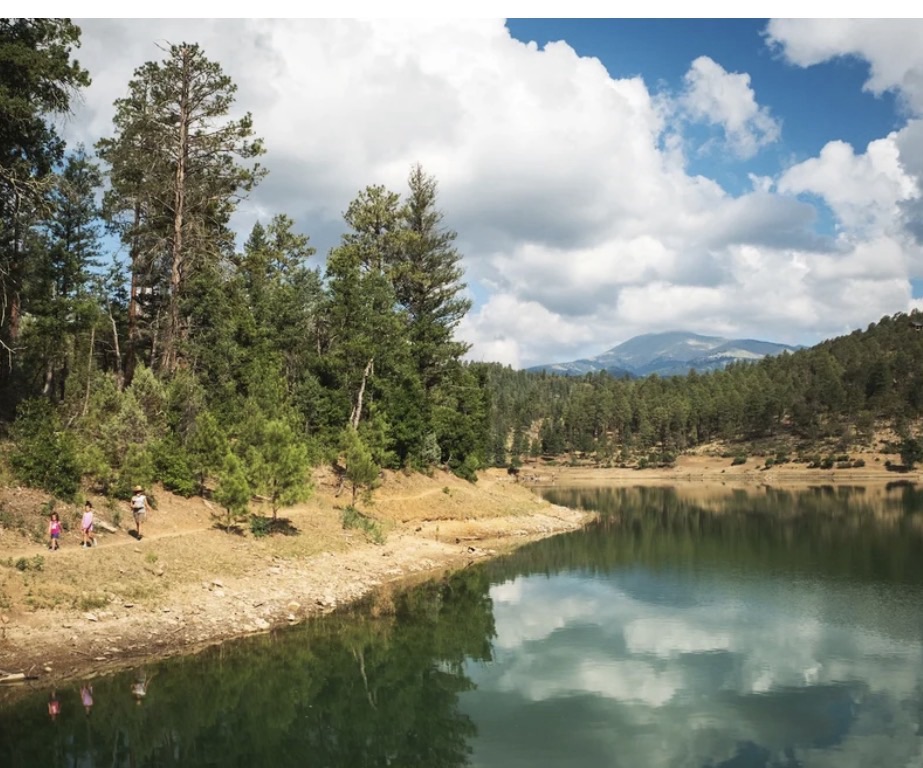
ALAMOGORDO, N.M. — A proposal by City Manager Robert Stockwell to build a fence around Bonito Lake was tabled Tuesday by the Alamogordo City Commission, which voted to take the matter up again in September — buying time for a community debate that has quickly moved beyond the fence itself and into a larger question: what is Bonito Lake worth to Alamogordo, and who should pay to keep it open?
The proposal, placed on Tuesday’s agenda by City Manager, Stockwell, would enclose the city-owned lake in Lincoln County, roughly an hour north of Alamogordo. Critics say fencing the lake would effectively end public fishing and day-use access at a site the city spent more than a decade and millions of dollars restoring after the 2012 Little Bear Fire and subsequent flooding forced its closure.
A Reversal of Course
The fence proposal marks a sharp departure from the direction set by prior city leadership — and, opponents argue, from the city’s own adopted policy.
In 2024, the Alamogordo City Commission voted 7-0 to approve a citywide Parks and Recreation Master Plan that included Bonito Lake as a component, describing the lake both as part of the community’s water supply and as an important regional recreational resource.
After the city refilled the lake, repaired the approximately 80-mile pipeline, and restored water delivery to the La Luz Water Treatment Plant, city staff under previous administrations began developing a phased plan to reopen the Bonito Lake campgrounds and restore recreational access, citing strong public support.
Opponents of the fence also point to the city’s seven-year “Open Gate” agreement with the New Mexico Department of Game and Fish, which was specifically intended to provide public fishing access at the lake.
Under that agreement, the city was prepaid for providing access — and with approximately six years still remaining on the term, ending public access now would obligate the city to repay those funds to the state. Fencing the site, opponents contend, would raise serious questions about the city’s commitments under both the agreement and the commission-approved master plan.
The City Manager’s Case: Costs and Who Benefits
In a text message exchange with Alamogordo Town News, Stockwell laid out the financial reasoning behind his position.
“Even when the campground was functional the fees did not cover the full cost,” Stockwell wrote, adding, “What percentage of the ‘locals’ pay city water bills and taxes to the general fund.”
Stockwell argued that the economic benefits of recreation at the lake flow largely to Lincoln County and Ruidoso rather than to Alamogordo, and that neither provides funding to maintain recreation access at the site. “The pool parks and recreation all occur in Alamogordo not Lincoln county,” he wrote, framing his role as one of fiscal stewardship: “My job is to advise the city commission and be responsible to them and the citizens of Alamogordo for using the financial resource entrusted to us for good of Alamogordo.”
He also pushed back on the idea of using Lodgers’ Tax revenue — a tax paid by visitors staying in Alamogordo hotels — to support the lake. Using those funds “to improve a campground that directly competes with those very rooms,” while “the meals not cooked around the campfire are being purchased in Ruidoso,” would work against the city’s own hospitality industry, he argued, noting that a significant portion of Lodgers’ Tax must by law be spent promoting Alamogordo as a destination.
The exchange grew pointed at times. When Alamogordo Town News cited a figure of 1,056 visitors to the lake last year and argued that many were local residents — this reporter having personally taken a group of eight to the lake — Stockwell responded by questioning how many of those “locals” actually pay into the city’s general fund. When Alamogordo Town News raised the city’s spending on legal payouts and ongoing litigation, Stockwell replied that he has “nothing to do with the payouts” and could not comment on active litigation.
The Other Side: ‘Does the Zoo Pay for Itself?’
Opponents of the fence, including former city staff, argue that a strict self-sufficiency test has never been applied to any other city recreation facility — and shouldn’t start with Bonito Lake.
Alamogordo Town News research puts it bluntly: Does the Recreation Center pay for itself? Does the zoo? Do the parks? The answer is no — and the city does not close those facilities because their revenue falls short of operating costs.
Public recreation exists to provide public benefit: tourism, family activity, community identity, and quality of life. If self-sufficiency becomes the standard for Bonito Lake, the same standard would logically have to apply to every park and amenity the city operates.
That research also emphasizes history that cannot be measured solely on a spreadsheet. The Bonito Lake area contains a historic orchard with trees more than 100 years old, including rare and potentially endangered apple varieties. Parks and Recreation staff had reportedly pursued DNA testing to determine whether some trees could be linked to varieties historically associated with Johnny Appleseed.
A Funding Plan That Was Already in Motion
Perhaps the sharpest dispute is over whether the city has exhausted its funding options before proposing to restrict access.
According to sources and city documents available via IPRA, former Acting City Manager Dr. Stephanie Hernandez and former Parks and Recreation Director Bass worked with former Mayor Payne, Mayor Pro Temp Sharon McDonald and then-state Senator Nick Paul on a proposed amendment to New Mexico’s Lodgers’ Tax statute. The initiative was also supported by then-Mayor Pro Tem McDonald — now Alamogordo’s mayor — who has recognized the importance of public spaces and natural resources to the community. The change would have added property “owned by the municipality” to the statutory language, potentially allowing Lodgers’ Tax revenue to support a municipally owned recreation destination located outside city limits.
Under that concept, roughly 60 percent of available Lodgers’ Tax revenue — approximately $200,000 annually — could have been directed to Bonito Lake operations, creating a dedicated tourism-based funding source rather than drawing on the city’s General Fund, with no new property tax or utility charge on Alamogordo residents.
Senator Paul’s district included both Otero County and the Ruidoso area. When he left office, the effort was expected to be carried forward by Senator Townsend, though it apparently stalled.
“I reached out a couple of times to Senator Townsend’s office and believe I received a response from his aide. It did not appear to be a priority for the Senator at that time,” the former acting city manager Dr. Hernandez said. “The Senator or his staff should still have the proposed language I developed, and I believe it remains a feasible option if the City wants to pursue it.”
The broader funding plan developed under prior leadership also included charging reasonable overnight camping and facility fees as the campground was phased back into service — a distinction supporters draw carefully: charging for optional overnight use is different from charging for fishing access, which could remain free and consistent with the Open Gate agreement.
Depending on how the campground was structured under state law, qualifying overnight stays might themselves have generated additional Lodgers’ Tax revenue. Staff were also directed to aggressively pursue state and federal grants and funding through New Mexico’s congressional delegation so improvements could be phased in without falling entirely on the General Fund.
The city even had and still has data tools in place to inform those decisions. Through a subscription to Placer.ai, staff could evaluate visitation patterns at the lake, including geographic and ZIP-code data — information the former acting city manager said had previously been provided to legislators. Critics say that data should be reviewed before any decision to restrict access.
And even when visitors come from outside Alamogordo or outside New Mexico, supporters argue, the spending still generates gross receipts tax revenue for the state, a portion of which returns to Alamogordo. Bringing new money into New Mexico, they say, is a win regardless of where the visitor sleeps.
A $1 Million Fence — and the Potholes It Won’t Fill
Then there is the price of the fence itself. Enclosing Bonito Lake is estimated to cost up to $1 million in construction alone, before accounting for ongoing maintenance and upkeep of the barrier — a recurring expense that would continue year after year.
That figure lands hard with residents who note the city has no shortage of competing priorities closer to home, chief among them the condition of Alamogordo’s streets. Critics ask why a city manager making a fiscal-responsibility argument against operating the lake would propose spending seven figures on a fence — and then paying to maintain it — rather than putting that money toward fixing roads and potholes inside the city.
The irony was not lost on either side of the text exchange. When Alamogordo Town News told Stockwell the city should “save the taxpayers money and fix some pot holes,” the city manager replied, “I agree we need to fix potholes – in Alamogordo, not Lincoln County.
Opponents counter that a fence in Lincoln County fixes potholes nowhere — and, combined with the repayment owed to the state under the Open Gate agreement, could leave the city spending well over $1 million to close the lake.
Social Media Outcry: ‘Leave It Open!!’
Word of the proposal has ignited a firestorm on social media, where opposition has spread far beyond Alamogordo. A widely shared post from Bonito Bait and Supply, a business near the lake, urged supporters to act before the commission takes the matter up again.
“If nobody says anything Bonito Lake will close, if enough people speak up it will remain open,” the business wrote, calling on the public to contact the City of Alamogordo, the mayor’s office, city commissioners, and Alamogordo Parks and Recreation with “emails and angry phone calls” — and organizers are encouraging a large turnout at the September 22 commission meeting to speak against the proposal during public comment.
The reaction in the comments has been swift and overwhelmingly opposed to the fence.
“Wowow the ignorance of our leaders!!! Leave it open!!” wrote Tito Corriz.
“If Bonita Lake gets closed that will be another blow to the economy for all the business in and around the village,” wrote Connie Goyne, noting the region has already lost the racetrack revenue. “Do everything possible to keep Bonita Lake.”
Others raised legal and practical questions. Commenter Jake Madril pointed out that while the city owns the lake, the surrounding land belongs to the Lincoln National Forest — asking whether fence posts would have to be placed on federal land — and cited Attorney General Raúl Torrez’s position that blocking public access to the shorelines of lakes, rivers, and streams is illegal in New Mexico.
The economic stakes drew some of the starkest warnings. One commenter, writing as Zealfish Bones Turnbow, said his team’s business plans “will change overnight” if the lake closes: “Many will pick up stakes, sell properties and never look back… Zero future investment $s to Alamogordo, Roswell, Ruidoso and Capitan — it’s that seriously vital to us that the lake be kept open to the public.”
Bonito Bait and Supply itself described the regional ripple effect, noting that on big tourist weekends stores in Ruidoso and Alamogordo routinely sell out of fishing supplies, and that lake visitors rent Airbnbs and spend money in the local economy before and after fishing. Closing the lake, the business wrote, “would be a massive economical blow to the entire area.”
The lake’s pull extends well beyond New Mexico. “I’m from Texas. I go fishing once a month up there,” wrote Ray Paz. “Been going over there for over 40 years. We camp by the stables every summer. Is anything we can do to help save the lake?”
Not every voice was purely critical. Commenter Cathie Rene’ Eisen urged residents to channel the energy constructively — writing to city officials and State Parks with alternatives, including the possibility of another entity managing recreational use so that public users help fund the lake’s operation. “Think of solutions and act on them,” she wrote. “This is what government is here for. We have to work together.”
Generations of Memories
For many residents, the debate is not primarily about spreadsheets. When Bonito Lake reopened, former Mayor Susan Payne spoke about what the lake had meant to generations of families. During discussions of emergency funding for retention ponds and watershed protection, one contractor on the project told officials the work was personal — he had his own memories at the lake.
For more than a decade after the Little Bear Fire, an entire generation of local children lost the chance to make those memories. Supporters of continued access say that after years of work, millions in investment, reconstruction of the pipeline, restoration of the watershed, and the return of water to Alamogordo’s taps, the city should be cautious about walling off the lake’s recreational future simply because operating it costs money.
What Happens Next
The full commission is expected to take up the fence proposal again at its September 22, 2026 meeting.
Between now and then, the questions on the table are likely to include whether the Lodgers’ Tax legislation remains viable, what the Placer.ai visitation data actually shows, how a fence would square with the Open Gate agreement and the 2024 master plan, what repayment to the state would actually cost, whether up to $1 million in fencing plus ongoing upkeep is the best use of city funds against needs like street repair, and whether the funding strategy developed under prior leadership was ever fully pursued.
As Alamogordo Town News research frames it, the question should not simply be whether the 70 year old Bonito Lake pays for itself. The better question: What is Bonito Lake worth to this community and its history — and has the city truly exhausted the funding options available before taking away something that took more than a decade to restore?
More News from Alamogordo
- Children’s Music Theater of Alamogordo Brings “Frozen” to the Flickinger Stage This October Over 50 local children participating to put on Frozen the Musical…
- No Officers Hurt in Fatal Alamogordo Police Shooting; State Police Investigating Developing story officer involved shooting…



Leave a Reply