
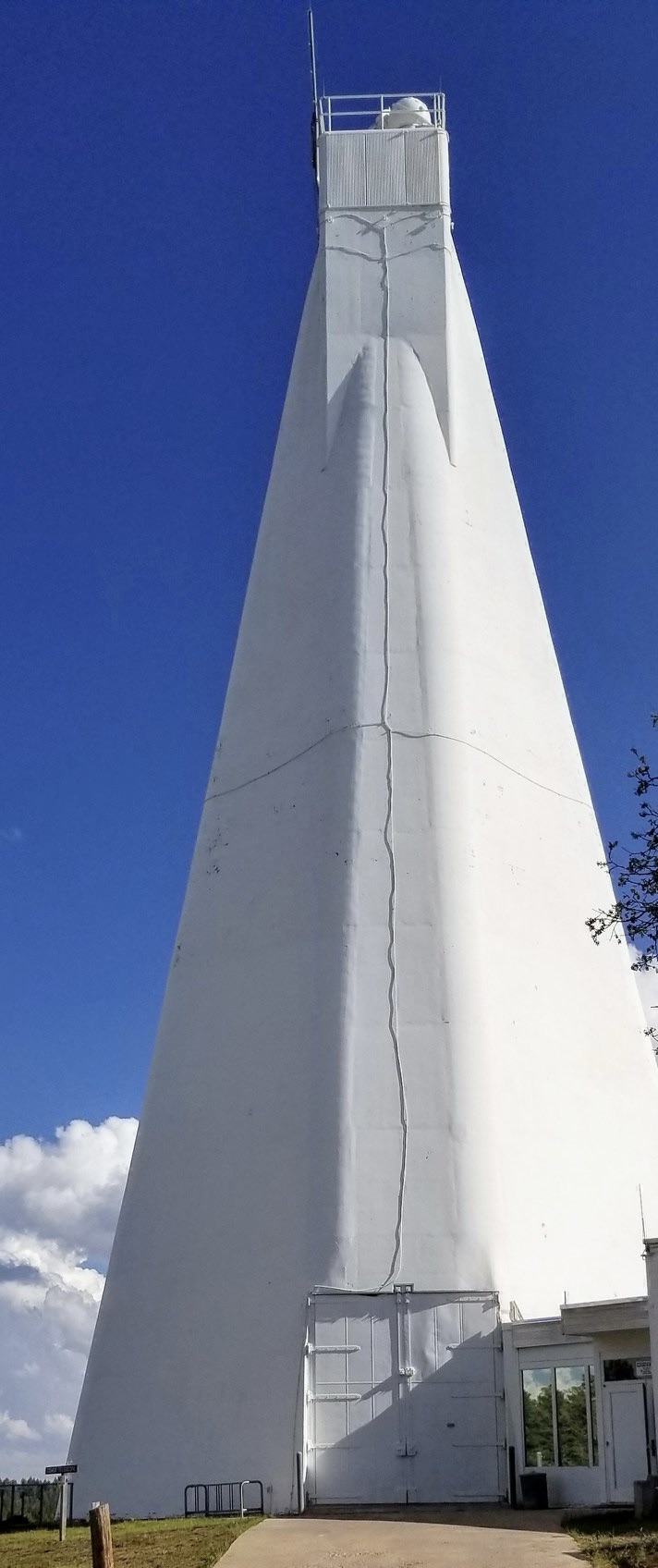
The National Science Foundation estimates that it will cost about $26 million to demolish Sunspot Solar Observatory’s smaller telescope buildings plus offices, housing and other structures, according to the NSF Fiscal Year 2026 Financial Report, released on Nov. 13. NSF also continues to claim that the site must be demolished because of a mercury leak that affects only one building.
NSF’s budget summary shows it ended the year with an unobligated balance of almost $1.9 billion, of which $1.4 billion is in Research and Related Activities, NSF’s primary funding account.
As covered in earlier ATN stories, the landmark Dunn Solar Telescope released about 186 pounds (6 quarts) of liquid, elemental mercury from a large bearing that let the telescope’s main barrel and observing platform rotate smoothly as they observed the Sun. An engineering inspection revealed a crack in a faulty weld, apparently there since the Dunn was completed in 1969. Concerned that the leak could reopen and spill the 18,000-pound load of mercury, NSF decided to drain all the mercury and to demolish the Dunn and the rest of Sunspot.
In Note 6. Environmental and disposal liabilities (pg. 29), NSF repeats its claim that it is “demolishing Sacramento Peak Observatory, including the visitor center, due to a mercury leak from the Dunn Solar Telescope,” although it has never identified any contamination outside the Dunn. Demolition of the Dunn is scheduled to be complete by late March 2027, with the rest of Sunspot gone by Fall 2027. Sunspot Community Center and Basin Alliance are leading efforts to preserve as much of Sunspot as possible for dark sky astrotourism and other historical educational purposes.
Sunspot started in 1947 as one of the first space weather forecasting stations, with two observers and a telescope operating out of the back of a truck. It soon grew into a world-class solar science research center with the Dunn, the Evans Solar Facility, and Patrol Dome/Hilltop Lab. Because it was a remote installation — Sunspot highway was not built until the 1960s — included a village with 35 houses (only 16 remain), a VIP apartment with dormitory, and a community center. NSF took over in 1976 following a change in Federal funding.
NSF has allocated up to $20 million to demolish the Dunn. Of that, $13.7 million has been obligated to Thornton Tomasetti, an international engineering firm. As of Sept. 30 (the end of Federal fiscal year 2026), NSF estimated that demolition of the rest of Sunspot would cost another $26 million as compared to $1.5 million a year to operate, as reported in other sources.
Note 6 also reports asbestos liabilities of $45 million for all of NSF’s facilities. It has no breakdown for sites, although Sunspot has asbestos insulation, ceiling tiles, and flooring adhesives, as well as lead-based paint and plumbing, all consistent with 1950s and ‘60s construction practices. Federal law requires that these be safely removed before demolishing a building. Despite the age of those buildings, NSF reports it “does not have any deferred maintenance to report … .”
Note: The author, Dave Dooling is a veteran science writer and former education officer at the National Solar Observatory.
More News from Alamogordo
- County Shooting Range Draws 227 Competitors From 14 States as Championship Match ReturnsThe Sidney Paul Gordon Shooting Range served nearly 1,500 people in October update…
- Alamogordo Native’s ‘The Cosmic Trigger: Trinity 1945’ Earns Five International Festival HonorsCo-directed by Larry L. Sheffield and Trent J. Di Giulio wins acclaim

Leave a Reply